
Choosing hardwood flooring for a custom home in Monument or Colorado Springs is not the same decision you would make in Denver or along the lower Front Range. At 6,800 to 7,200 feet, winter humidity inside a forced-air heated home can drop below 20 percent, and the wrong species or installation method will show it fast.
Ivory Ridge Custom Home Builder builds and remodels across El Paso County, from Monument down through Colorado Springs, and we plan hardwood flooring options into the project before a single footing is poured, so the floor you pick on day one still looks right ten years in. Talk to our team about flooring before your build begins.
Key Takeaways
- Monument's elevation and forced-air heating create low indoor humidity that makes species selection and acclimation critical for hardwood flooring.
- Engineered hardwood handles Colorado's dry winters better than solid hardwood in most custom home applications.
- Subfloor moisture testing on concrete slabs is a required step before any hardwood flooring installation in homes with basements.
- Planning your hardwood flooring options early in the design phase prevents costly corrections after framing is complete.
- Wide-plank white oak and hickory are common specifications in new Monument custom builds for good reason: both perform well in dry, high-elevation conditions.
Why Colorado's Dry Air Drives Every Flooring Decision

Picking hardwood floors in Colorado is a technical decision before it is an aesthetic one. In northern El Paso County, indoor relative humidity during the heating season routinely falls below 20 percent. That is drier than most desert climates, and it is the single biggest reason hardwood floors fail here in ways they would not in Denver, Fort Collins, or anywhere east of the Front Range.
The failure modes are specific. Solid hardwood planks gap between boards as moisture leaves the wood. Wider planks cup along the edges. Species with poor dimensional stability crack across the face within a single winter. These are not installation errors. They are the result of choosing the wrong product for this climate before a single footing is poured.
Ivory Ridge Custom Home Builder handles our Colorado Springs custom home builds across El Paso County, Castle Rock, and the surrounding foothill communities. This guide covers every hardwood flooring decision that matters at these humidity levels, from species selection and installation to whether refinishing beats full replacement.
Solid Hardwood vs. Engineered Hardwood: Which One Belongs in a Colorado Home?
This is one of the first flooring decisions you will make in a new custom build, and it is also one of the most misunderstood. The answer depends almost entirely on where you are building and how your home is conditioned. In El Paso County, the climate makes this choice more consequential than in most parts of the country.
What Solid Hardwood Actually Is
Solid hardwood is a single plank of wood, typically 3/4 inch thick, milled from one piece of lumber. It looks beautiful. It can be sanded and refinished three to five times over its lifetime. That is a real advantage for a home you plan to keep for decades.
The problem is physics. Wood expands and contracts with changes in humidity. A 4-inch solid oak plank can shrink by 1/8 inch or more across its width when indoor relative humidity drops to 15 to 25 percent. That is not a defect. That is wood behaving exactly as it should. During Colorado's forced-air heating season, indoor RH regularly hits that range, and gaps appear between planks. This is predictable, not a surprise.
Why Engineered Hardwood Performs Better in Colorado
Engineered hardwood is real wood. The top layer is a hardwood veneer, typically 2 to 6mm thick, bonded over a cross-ply plywood core. That cross-ply construction resists movement across the grain. When your furnace runs hard through a Woodmoor winter and indoor humidity drops, engineered hardwood holds its shape far better than solid.
That is why engineered hardwood is the more common specification in Colorado Springs and northern El Paso County custom builds. At our elevation, where heating systems run longer and harder than in lower Front Range cities, solid wood floors take on more stress than the product is designed to absorb. Engineered hardwood can still be refinished one to three times depending on veneer thickness, which is enough for most homeowners across a 20 to 30 year ownership window.
Cupping is the other failure mode to know. If a swamp cooler or whole-home humidifier spikes indoor moisture in summer, solid planks can cup at the edges. Engineered hardwood is significantly more resistant to that movement as well.
When Solid Hardwood Still Makes Sense
Solid hardwood is not the wrong choice in every Colorado home. It performs well above grade in rooms with whole-home humidification systems that hold RH between 35 and 50 percent year-round. Tight building envelopes in newer custom builds help. Historic homes where authenticity is a requirement are another case where solid hardwood is the right call, even with the maintenance trade-offs.
The decision should be made early in the design phase, not after framing is complete. Know your humidification plan first, then choose your flooring.
Not sure whether solid or engineered belongs in your build? We spec flooring before framing starts, so the product matches your humidification plan and subfloor.
The Best Wood Species for Colorado Springs and Monument Custom Homes
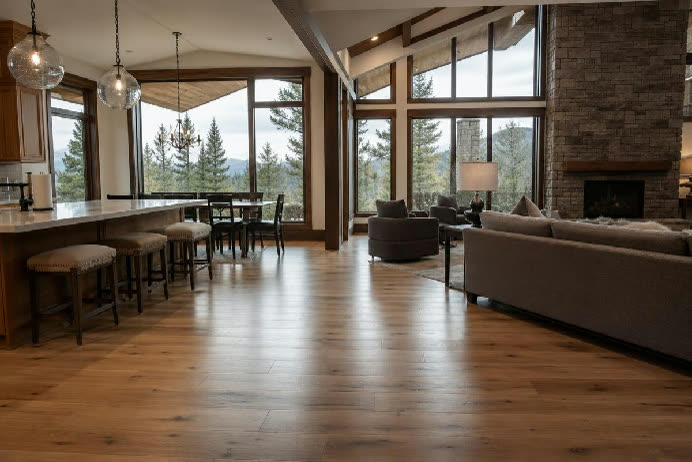
Not every wood species handles Colorado's dry winters equally well. At elevation, indoor moisture during the coldest months puts real stress on softer, more reactive species. Choosing the right hardwood flooring options for your custom home starts with understanding which species are built for these conditions and which ones will give you trouble.
Hardest and Most Durable Species
Hickory sits at 1820 on the Janka hardness scale, making it the top pick for high-traffic areas like great rooms, mudrooms, and open-plan kitchens. Its pronounced grain variation is a practical advantage too: minor scratches and dust simply disappear into the pattern. In El Paso County new builds with active families and large dogs, wide-plank hickory is one of the most common specifications we see.
White oak comes in at 1360 Janka and has become the dominant species in current custom home builds nationally. Its neutral, slightly cool undertone works well with gray and white palettes, and it is widely available in engineered format, which matters in Colorado's dry climate. Hard maple reaches 1450 Janka but shows scratches more readily because of its tight, light grain. Beautiful in the right space, but it punishes high-traffic areas.
Mid-Range Durability Species
Red oak scores 1290 Janka and remains the most widely installed species in the country. It is broadly available prefinished, which simplifies scheduling on new builds. Walnut (1010 Janka) is a premium choice for lower-traffic rooms like formal dining rooms, home offices, and primary bedrooms. For kitchen remodeling in Colorado Springs, walnut is generally not the right call unless the household is low-traffic.
Cherry sits at 950 Janka, the softest on this list, and is not a good fit for homes with dogs or heavy foot traffic, though its warm reddish-brown color deepens beautifully with age in the right setting.
How to Evaluate Hardwood Flooring Options for a Colorado Climate
The Janka scale measures the force in pounds required to embed a 0.444-inch steel ball halfway into a wood plank. Higher numbers mean more resistance to denting and surface wear. That said, Janka is a starting point, not the whole answer. Grain pattern, finish quality, board thickness, and surface texture all affect real-world durability.
In Colorado's dry, dusty conditions, a wire-brushed or hand-scraped surface texture on any species will hide daily wear far better than a smooth finish, regardless of the hardness number.
Prefinished vs. Unfinished Hardwood: What the Choice Costs You in Time and Money
The prefinished vs. unfinished hardwood flooring decision is not just about aesthetics. It directly affects your project timeline, your family's daily life during construction, and the long-term appearance of the floor. Here is what that trade-off actually looks like on a real job site.
Prefinished Hardwood
Prefinished boards arrive with 6 to 10 factory-applied coats of aluminum-oxide finish, UV-cured to a hardness no on-site crew can match with a brush or roller. The manufacturer warranty comes with it. Installation moves faster because there is no sanding or finish work after the boards go down.
The trade-off is the micro-bevel. Every prefinished board has a small beveled edge where it meets the next board. That groove collects dust. At these humidity levels, fine particulate settles into those seams constantly. It is a real maintenance consideration, not a minor cosmetic one.
Unfinished Hardwood
Unfinished hardwood is sanded and finished on-site after installation. The finisher sands across the entire floor surface, which eliminates the micro-bevel and produces a truly flush appearance. You also get more finish options: oil-modified polyurethane, water-based polyurethane, hard-wax oil, or penetrating oil. Water-based formulas carry lower VOC levels, which matters if you are sensitive to fumes or returning to the space quickly.
The cost is time. On-site finishing adds 3 to 7 days to your schedule for sanding, application, and curing. The space must stay vacated and ventilated throughout. That is real money and real time on any active project.
New Build vs. Remodel: Which Finish Type Fits Your Project
In a new custom build, the space is already empty and the schedule can absorb finishing time. Unfinished hardwood is usually the stronger long-term call for appearance and finish quality. If you are planning a new home with our custom home construction team, we factor flooring finish type into the schedule at the planning stage before framing begins.
In an occupied home remodel, prefinished is often the practical answer. Fewer disrupted days, no fumes, and a durable factory finish that performs well in daily use. For home remodeling in Colorado Springs, we walk through both options with you at the planning stage so the choice fits your timeline and your household, not just the product spec sheet.
How Colorado's Climate and Altitude Change the Way Hardwood Floors Are Installed
Colorado's dry air is not a minor variable. It is the single biggest factor that separates a hardwood floor installation done right here from one done right somewhere else. At elevations above 6,000 feet, forced-air heating systems run hard all winter and pull indoor moisture down to punishing levels. Skip the climate-specific steps, and you will be looking at gapped, cupped, or buckled floors within one winter.
Acclimation: Why It Matters More in Colorado
Hardwood floor installation in Colorado's dry climate demands a minimum of 3 to 7 days of on-site acclimation before a single board is fastened down. The flooring needs to sit stacked in the installation room with the HVAC running at normal operating conditions. That means the heat is on, the house is at its typical winter temperature, and the humidity is where it will actually be when the family moves in.
Homes along the Air Force Academy corridor are frequently built with full basements and open floor plans, where temperature and humidity can vary significantly from room to room. Acclimate in the wrong space and you have solved nothing. We have seen floors installed by previous contractors that skipped this step entirely. The gapping that shows up by February is not a product defect. It is a process failure.
Subfloor Moisture Testing
Concrete slabs are standard in Colorado basements and slab-on-grade construction. Concrete releases moisture vapor even when it looks and feels completely dry. The industry standard for testing is ASTM F2170 in-situ relative humidity testing. For most hardwood adhesive systems, the slab must test below 75 to 80 percent RH before installation begins. Skipping this test on a Colorado Springs slab can void the flooring manufacturer's warranty outright.
For wood subfloors, the moisture content of the subfloor and the hardwood planks themselves must be within 2 to 4 percentage points of each other. Use a pin or pinless moisture meter on both. This is a non-negotiable step on any custom home project we manage.
Installation Methods for Colorado Conditions
Nail-down or staple-down is the correct method for solid hardwood over a wood subfloor. Glue-down is required for solid or engineered hardwood over concrete. Floating click-lock systems work well for engineered hardwood in basement applications, but they need expansion gaps of 3/8 to 1/2 inch at every wall. In a dry Colorado climate, that gap is not optional. During a summer monsoon or a humidifier malfunction, the floor will expand. Without that gap, it buckles.
Planning hardwood floors for a new build or remodel in the Colorado Springs area? Our team plans for Colorado's climate from the start. Call us at (719) 426-1130 to talk through your project.
Should You Refinish Existing Hardwood or Replace It Entirely?
This decision comes down to two things: how much wear layer is left on your floor, and what the project scope around it looks like. Get those two answers right and the math usually tells you what to do.
Can Your Floor Be Refinished?
Solid hardwood can typically be sanded and refinished three to five times over its lifetime, depending on the wear layer above the tongue. A standard 3/4-inch board with a 1/4-inch wear layer has real life remaining. Engineered hardwood is a different story. A 2mm veneer can usually handle a light screen and recoat once. A 4 to 6mm veneer can take one or two full sands.
Colorado's dry climate works against finishes over time. Low indoor humidity in the Tri-Lakes area makes finish layers brittle faster than in lower-elevation markets. A floor that looks rough may have more life left than it appears. Have the wear layer measured before you commit to anything.
Signs a floor cannot be refinished: boards thinner than 5/16 inch at the wear layer, deep structural damage, cupping that cannot be flattened by sanding, or pet staining that has soaked through to the subfloor.
Cost Comparison: Refinishing vs. Replacement
Refinishing costs depend on the floor's condition, finish type, and square footage. Full replacement of engineered hardwood varies based on species, plank width, and subfloor prep. Pricing varies. Contact us for an estimate based on your specific project. If the floor has life remaining, refinishing wins on cost almost every time.
When Replacement Is the Right Call
Structural damage, subfloor problems, or a layout change that disrupts the floor anyway all justify replacement. The clearest case is a full kitchen remodel in Colorado Springs. The floor gets pulled regardless, so the opportunity cost of refinishing disappears. That is the moment to upgrade the species, plank width, or hardwood flooring options entirely rather than restore what was there before.
Hardwood Flooring in Monument and the Colorado Springs Foothills: What Local Builders Know
Building custom homes in the foothills north of Colorado Springs means working with conditions that most flooring guides never account for. The Jackson Creek and Jackson Ranch corridors sit at high elevation, and that altitude changes nearly every decision in a hardwood flooring specification.
Elevation and Dry Air: The Monument Difference
Forced-air heating systems run harder and longer up here than they do in lower parts of the Front Range. This is the most challenging hardwood environment in the region, and it is why hardwood floor installation in this area requires planning that starts well before materials are ordered.
If you want solid hardwood in a custom build at this elevation, a whole-home humidifier is not optional. It is a practical necessity. That conversation should happen during our custom home building process, not after the floor is installed and you are watching gaps open between boards mid-January.
Flooring Choices in Colorado Custom Builds
The most common specification we see in new custom builds along the Jackson Ranch corridor is engineered hardwood in white oak or hickory, wire-brushed with a matte finish. Wide-plank formats in the 5 to 7 inch range are popular, but wider boards move more with humidity swings. Tighter humidity control is required if you go that route.
Homes in this area are also frequently built on larger lots with full basements. Subfloor type varies. Concrete slab subfloors require moisture testing before any hardwood goes down, and the flooring spec should be confirmed against the actual subfloor before material orders are placed. Flooring transitions, stair nosings, and thresholds are finish carpentry details that matter here too. They affect long-term performance, not just appearance.
If you are planning a new build in this area, Ivory Ridge Custom Home Builder works through these decisions before framing begins.
Frequently Asked Questions
What is the most durable hardwood flooring for a Colorado home with pets and kids?
Hickory and white oak are the top choices. Hickory rates 1820 on the Janka hardness scale. White oak comes in at 1360. Both handle heavy foot traffic, pet nails, and dropped toys without showing damage as quickly as softer species. Choose a wire-brushed or hand-scraped surface texture. Those finishes hide everyday scratches far better than a smooth, high-gloss face.
Can I install solid hardwood over a concrete slab in Colorado?
Not without proper prep. Concrete slabs require ASTM F2170 moisture testing before any wood goes down. Skip that test and you risk cupping and buckling within months, and you will likely void the manufacturer's warranty. Use a sleeper system or choose engineered hardwood rated for glue-down over concrete. Homes in the Black Forest and Castle Rock areas often have slab-on-grade sections where this step is non-negotiable.
How long does hardwood floor installation take in a new custom home build?
Plan for two to three weeks total. Acclimation alone takes three to seven days at Colorado's elevation and low humidity. A skilled crew installs roughly 1,500 square feet in two to four days. If you chose unfinished hardwood, add another three to seven days for sanding and finishing. Build that window into your schedule before the final walkthrough.
What finish holds up best in Colorado's dry climate?
Water-based polyurethane or hard-wax oil. Water-based dries faster and has lower VOCs. Hard-wax oil penetrates the wood and is easier to spot-repair, but it needs more frequent maintenance. Avoid high-gloss finishes. In Colorado's dry climate, gloss surfaces show dust and fine scratches constantly because of the persistently low indoor humidity.
Is engineered hardwood better than luxury vinyl plank for a Monument custom home?
For a higher-end custom build, engineered hardwood wins on resale value and refinishability. LVP is fully waterproof and costs less upfront, but it does not add the same long-term value. Buyers in Woodland Park and the Colorado Springs foothills expect real wood in a custom home at a higher price point. Engineered hardwood delivers that, and it holds up well in Colorado's climate when installed correctly.
What does hardwood flooring installation cost in Monument and Colorado Springs?
Hardwood flooring costs in Colorado Springs vary based on species, plank width, finish type, and subfloor conditions. For broader context on where flooring fits in your overall budget, see our cost guide for building a custom home in Colorado. Get a firm quote from your builder before committing to a species and format.
Ready to plan the flooring package for your custom home? Our team works through every finish decision before the first nail goes in. If you are building with Ivory Ridge Custom Home Builder, call us at (719) 426-1130 or contact our team to start the conversation. Ivory Ridge Custom Home Builder operates from 7222 Commerce Center Dr Suite 220, Colorado Springs, CO 80919, and serves Castle Rock, Black Forest, Woodland Park, and the surrounding communities.
Ready to Get Started with Ivory Ridge Custom Home Builder?
Call (719) 426-1130 to speak with our team directly. We are ready to answer your questions, walk you through your options, and help you find the right solution for your needs. Whether you are just starting to plan or ready to move forward, we will make the process simple and stress-free. Reach out today and let us talk about how we can help.