

Buying land in Colorado sounds straightforward until you pull a specific parcel in El Paso County and realize zoning, water access, soil conditions, and permit timelines can each stall or sink your project before construction ever starts. Most people focus on price per acre. The details that actually determine whether you can build, and what it will cost, are buried in county records, water district maps, and geotechnical reports.
Ivory Ridge Custom Home Builder works through those details on real parcels every week, and this guide covers what to verify before you commit to a purchase price. Have a parcel in mind? Talk to our team before you sign anything.
Key Takeaways
- Buying land in Colorado requires checking zoning, water rights, and utility access early, not after you are under contract.
- El Paso County building permit review for new custom homes typically runs 8 to 16 weeks from a complete application.
- Parcels in Black Forest and the Monument corridor carry specific WUI and water augmentation requirements that add real cost and time.
- Soil conditions in this region vary significantly by parcel, and a geotechnical report can prevent costly foundation surprises.
- Lining up your builder before you close on land helps you avoid buying a site that cannot support your planned home.
Why Land Due Diligence Matters Before You Buy

A parcel can look perfect on a listing sheet and cost you six figures in site prep, utility extensions, or permit delays before a single footing is poured. That gap between what a listing shows and what a lot actually costs to build on is where buyers get hurt. Purchasing raw land in El Paso County is not like buying a finished lot in a subdivision. Raw land carries hidden conditions that never show up in the price per acre.
Ivory Ridge Custom Home Builder has walked raw parcels throughout the Monument corridor, Black Forest, and Falcon, and the same expensive surprises come up repeatedly. Water access issues. Zoning classifications that block residential construction. Soil conditions that demand engineered foundations. Wildfire overlays that add tens of thousands to your build cost before framing starts.
We build across multiple Front Range counties, with our primary focus in El Paso County, so this guide reflects what we see on actual sites rather than generic advice. It is a pre-purchase due diligence resource, not a listing browser, written to help you ask the right questions prior to going under contract.
If you are also working through the broader process of How to Buy Land & Build a House in Colorado Springs, that companion guide covers the full timeline from site selection to move-in. This guide focuses specifically on what to verify before you sign anything.
- Zoning classification: Does the parcel actually allow a single-family residence?
- Water rights and well permits: Is there a legal, permitted water source, and what augmentation plan does it require?
- Utility access distance: How far is the nearest electric, gas, and sewer connection, and who pays to extend it?
- Soil and geotechnical conditions: Are there expansive clays, bedrock, or slope issues that drive up foundation costs?
- Wildfire and flood overlays: Is the parcel in a WUI zone or FEMA flood area with added construction requirements?
- Permit authority: Which jurisdiction controls your permits, and what does that mean for your timeline?
Our team builds custom and luxury homes across the Colorado Springs area and evaluates land as part of that process. What follows covers each of these issues in plain terms, with the local specifics that actually affect your project.
Zoning and Land Use Checks to Make Before Any Offer
Colorado land due diligence starts with zoning, and in the Monument corridor, that means understanding exactly which designation covers your parcel before you spend a dollar on due diligence elsewhere. Unincorporated parcels north of Colorado Springs fall under county planning authority, not the Town of Monument or the City of Fountain, regardless of how close they sit to either boundary.
The county uses several key designations. A-35 requires a minimum of 35 acres per dwelling unit. A-5 drops that to 5 acres. RR-5 allows residential use on lots as small as 5 acres with more defined setback and height controls. RR-2.5 permits residential development on 2.5-acre parcels and is common in areas with existing infrastructure nearby. Each designation also controls setbacks, allowable structure height, and whether an accessory dwelling unit or secondary structure is permitted by right or requires a variance.
If you are looking at land near Woodland Park or Divide, stop. Those parcels route through the Teller County Planning Department, a completely separate entity from the county office that handles the areas north of Colorado Springs. Mixing up jurisdiction is a real mistake that delays projects by months.
What Zoning Restrictions Mean for Your Build Timeline
Colorado land zoning for construction rarely causes problems when the designation fits your plan. The trouble starts when it does not. A zoning variance or special use permit can add 60 to 120 days to your project before you even submit a building permit application. That delay hits your financing, your contractor schedule, and your overall budget. Working with a design-build contractor who knows the local planning process helps you identify those conflicts before you close, not after.
Watch specifically for the A-35 trap. Buying a 5-acre cut from a larger A-35 parcel without checking the subdivision history is a common and costly mistake. If the parent parcel was never properly subdivided, your 5-acre piece may not be a legal building lot at all.
Deed Restrictions, HOA Covenants, and Easements
Zoning is the county's rules. Deed restrictions are the land's rules, and they can be stricter. Some parcels carry older agricultural covenants from pre-subdivision eras that limit structure types or prohibit certain uses entirely. These do not show up in a zoning search. You need a title review that specifically flags covenants and restrictions.
Utility easements, drainage easements, and access easements can also cut significantly into your buildable area. A parcel that looks like two acres on paper may have 40 feet of utility corridor running through the middle of the best building site. Identify every easement on the plat map before you sign anything.
Water Rights and Well Permits: the Issue That Kills Colorado Land Deals
Owning a parcel in Colorado does not give you the right to use water on it. That surprises a lot of buyers. Colorado follows the prior appropriation doctrine, which means water rights are separate from land ownership and must be specifically acquired or verified. Surface water crossing your property belongs to whoever holds the senior water right, not to you.
For rural parcels in the Monument and Black Forest corridor, the primary water source is the Denver Basin aquifer. It underlies much of this region, but it is a non-renewable resource. New well permits here frequently require an augmentation plan through the Colorado Division of Water Resources, which adds both cost and months to your timeline. Some subdivisions in the Gleneagle area have existing augmentation plans that cover included parcels. Verify whether your specific parcel is inside one of those plans before you commit to a purchase price.
If a seller cannot produce a valid well permit or a written letter of commitment from a water provider, that is a deal-stopper. Do not proceed until it is resolved.
Municipal Water vs. Private Well: Real Costs to Budget
Well drilling in this region varies significantly depending on depth. Denver Basin wells in the Monument and Falcon areas often require 500 to 1,000-plus feet of drilling to reach usable water. That depth drives cost fast. Municipal water connection fees also vary depending on tap size and how far your parcel sits from the nearest main.
Neither option is cheap. Budget for it early. If you want to understand how water access affects the full build cost, our available homesites already have water access verified, which removes one of the biggest unknowns from land due diligence in Colorado. For a broader look at what land acquisition involves before you build, our team covers the full picture as a custom and luxury home builder in the Colorado Springs area.
Soil, Geology, and Site Conditions: What the Ground Tells You Before You Build
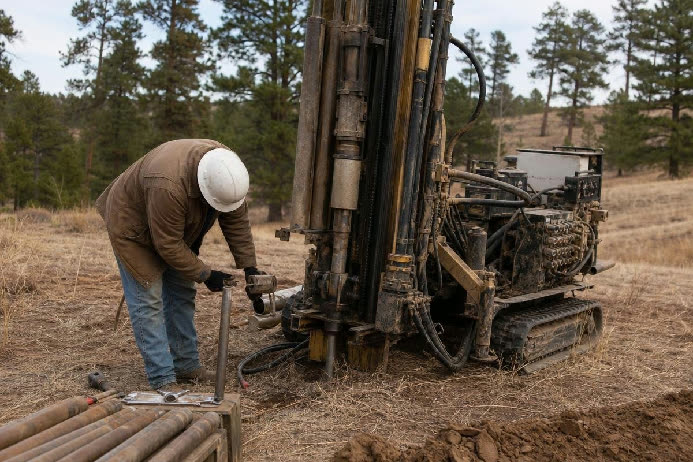
Much of the Monument corridor and Black Forest area sits on bentonite-rich clay and decomposed granite. These soils shrink and swell with moisture changes, and that movement is a leading cause of foundation failure in Colorado. A geotechnical report is not optional here. County permit authority requires one before a building permit is issued, and costs depend on parcel size and test depth.
What the geotech report tells you matters just as much as having it. If the soil has high expansion potential, a standard slab may not be permitted. Engineered alternatives like pier and grade beam, structural slabs, or crawl spaces with engineered footings add significant cost to your foundation. That is real money and real time, and it changes your budget early. Skipping the report to save $3,000 upfront can produce a $60,000 foundation redesign after permits are pulled. Get the report early, ideally before you close on the land.
Understanding our custom home building process shows exactly where site evaluation fits into the sequence so you are not caught off guard by these costs mid-project.
Slope, Drainage, and Flood Zone Designations
Parcels along Monument Creek and Fountain Creek drainages can carry FEMA flood zone designations, including Zone AE or Zone X shaded. Those designations affect your insurance costs and may require a finished floor elevation certificate before occupancy. Slopes greater than 15 percent trigger additional grading, retaining wall, and erosion control requirements under county grading ordinances. Both conditions add cost and extend your permit review timeline.
Wildfire Hazard Zones and WUI Requirements
Black Forest carries a Wildland-Urban Interface designation, a direct result of the 2013 Black Forest Fire. Parcels in WUI zones require Class A roofing, ember-resistant vents, defensible space clearing, and in some cases fire-resistant exterior cladding. The Rampart Range foothills carry similar requirements. Budget for WUI-compliant upgrades on top of your base construction costs.
The county maintains a WUI map online. Check it before you make an offer, not after. Get a free land evaluation before you make an offer. We will flag the soil, water, and access issues that never show up on a listing sheet.
Utility Access and Infrastructure: The Costs Most Buyers Underestimate
Buyers consistently underestimate what it costs to get utilities to a raw parcel. The land price is just the starting point. Electric, sewer, gas, and road access costs vary significantly depending on how remote the parcel sits.
Black Hills Energy is the primary electric provider across much of the Monument and Falcon corridor. Overhead and underground service extension costs vary by distance and terrain. A parcel sitting far from the nearest transformer can add significant electric infrastructure cost before your panel is even set. Natural gas is not available on many rural parcels in this area.
That means propane or all-electric systems, and that decision shapes your HVAC, water heater, and appliance selections from day one. Broadband availability varies widely, with many rural parcels still relying on satellite service despite recent expansion.
Septic System Requirements in El Paso County
Any parcel without municipal sewer requires an Individual Sewage Disposal System permit from county public health. Before that permit is issued, you need a perc test and soil evaluation. Standard septic systems vary in cost, and on poor-perc soils or steep slopes, an engineered system adds significant expense. That is real money, and it is non-negotiable.
A thorough site evaluation for your custom home in Colorado is the only way to know which category your parcel falls into before you close.
Road Access and Driveway Permits
A parcel with no deeded road access is legally landlocked. Full stop. County rules require a driveway access permit for any new connection to a county road. Parcels fronting a state highway, including Highway 83 and Highway 105 in the Monument corridor, fall under CDOT jurisdiction. A state access permit through CDOT can take 60 to 90 days. Private road maintenance agreements in rural subdivisions carry cost-sharing obligations worth reviewing before you sign anything.
If raw land infrastructure costs are pushing your budget past what makes sense, a home addition on a property where utilities are already in place is sometimes the more practical path. Not sure what your target parcel will actually cost to build on? Call us at (719) 426-1130 and we will walk the site with you before you commit.
What Land Actually Costs in the Monument and El Paso County Market
List price is not the same as true cost. That distinction matters more here than in most markets along the I-25 Front Range corridor. Smaller residential lots in the Gleneagle and Woodmoor areas, typically 0.5 to 2 acres with utilities already stubbed in, run roughly $80,000 to $200,000-plus. Larger rural parcels of 5 to 35 acres in unincorporated areas north of the city range from $100,000 to $500,000-plus, depending on views, road access, and how far utilities sit from the property line.
Parcels with Pikes Peak or Front Range views command a real premium, and that premium is priced in before you make an offer.
Parcels in the Divide and Cripple Creek areas often show lower sticker prices per acre. Do not mistake that for a better deal. Remoteness drives infrastructure costs up fast, and those costs hit your budget before ground breaks.
Hidden Costs That Change the Math on a Land Purchase
Land acquisition in the Monument corridor means budgeting well beyond the purchase price. These are the line items buyers consistently miss:
- Geotech report: $1,500 to $4,000
- Well drilling: $15,000 to $40,000
- Septic system: $15,000 to $60,000
- Electric extension: variable, often $10,000 to $50,000-plus depending on distance
- Driveway and grading: $10,000 to $40,000
- Wildfire mitigation upgrades in WUI zones: $10,000 to $30,000
- County building permit fees: typically 1 to 2 percent of total project valuation
Site work costs on a parcel with no utilities and poor soils can easily exceed the land purchase price. That changes the deal entirely. Our cost to build a custom home guide breaks down the full project budget so you know what you are actually committing to before you sign anything.
How Working with a Local Builder Before You Buy Changes the Outcome
Most buyers tour a parcel with a real estate agent. Agents know property lines, comparable sales, and contract terms. They are not trained to read surface drainage patterns, spot heaved ground that signals expansive clay beneath, assess driveway feasibility on a steep lot, or locate utility stub-outs. A builder walks the same ground and sees a completely different picture. Our team has evaluated parcels across the Pikes Peak region and neighboring Front Range counties, and we flag problems before a buyer goes under contract.
Site evaluation for a custom home in Colorado covers physical conditions that directly affect your budget. Slope, drainage flow, soil surface indicators, and access all shape what your foundation and site prep will actually cost. Catching a problem during a pre-purchase walk costs nothing. Discovering it after closing costs real money and real time.
Customers consistently tell us there were no surprises, that our team lived up to every commitment on quality and cost. That track record starts with honest site evaluation before ground breaks. We carry a 5.0 average rating across 17 Google reviews, and we operate from our base at 7222 Commerce Center Dr Suite 220, Colorado Springs, CO 80919, with primary focus on El Paso County and surrounding Front Range communities.
From Land to Permitted Plans: the Design-Build Advantage
When the same team that evaluates your land also designs and builds the home, site constraints shape the design from day one. You are not paying an architect to draft plans that a builder later has to revise around a drainage issue or a setback problem. Our design-build approach treats the land and the home as one connected problem, not two separate contracts.
Permit timing matters here. The county's building permit review for new custom homes typically runs 8 to 16 weeks from a complete application submission. A builder who knows the plan review process structures the application to avoid common rejection reasons, which protects your schedule. You can see exactly how we manage that timeline in our custom home building process. Getting this right before you break ground is what keeps a project on track.
Frequently Asked Questions
Do I need a builder before making an offer on land?
You are not required to, but it is the single highest-return step in land due diligence Colorado buyers consistently skip. A builder catches soil red flags, utility gaps, zoning conflicts, and access issues before you are under contract. Finding those problems after closing costs far more to fix than a pre-purchase site visit.
What is a geotechnical report and do I need one?
A geotechnical report is a subsurface investigation by a licensed geotechnical engineer. It determines foundation type and flags expansive soils, bedrock depth, or groundwater conditions. County permit authorities require one before issuing a building permit for new construction, so budget for it early.
How do water rights work in Colorado?
Colorado follows prior appropriation, meaning water rights are separate from land ownership and do not transfer automatically with a sale. For rural parcels, confirm well permit availability through the Colorado Division of Water Resources. Some areas require an augmentation plan, which adds both cost and time. Get a valid well permit or water provider commitment letter before closing.
How long does the building permit process take?
Plan on 8 to 16 weeks from complete application submission. Complex sites, engineered foundations, or properties in wildfire-risk zones can push that timeline longer. Factor this into your project schedule before you break ground.
What is a WUI zone and what does it cost to build in one?
The Wildland-Urban Interface designates areas where development meets undeveloped wildland, creating elevated wildfire risk. Parts of the Rampart Range foothills and areas northeast of the Palmer Divide fall within WUI boundaries. Building there requires Class A roofing, ember-resistant vents, and defensible space clearing, all of which add real money to your construction budget.
Can I build an ADU on rural land in this area?
It depends entirely on the zoning classification. Some rural residential zones allow an accessory dwelling unit by right; others require a special use permit or prohibit them entirely. If you are considering a mother-in-law suite or secondary unit, verify the allowance with the county's community development office before assuming it is permitted. Colorado land zoning for construction varies parcel by parcel, and assumptions here are expensive.
Ready to walk a parcel before you make an offer? Call Ivory Ridge Custom Home Builder at (719) 426-1130 or visit our contact page to schedule a pre-purchase site evaluation. Our team serves Peyton, Divide, and the surrounding Front Range communities across El Paso and neighboring counties. The right questions asked before closing save far more than they cost.
Ready to Get Started with Ivory Ridge Custom Home Builder?
Call (719) 426-1130 to speak with our team directly. We are ready to answer your questions, walk you through your options, and help you find the right solution for your needs. Whether you are just starting to plan or ready to move forward, we will make the process simple and stress-free. Reach out today and let us talk about how we can help.